

How Real-Time Monitoring Can Prevent Legionella Outbreaks Before They Start
|
When it comes to Legionella prevention, the difference between a safe water system and a public health incident can be measured in hours.
Traditional testing and manual inspections, often conducted monthly or quarterly, leave wide gaps for bacteria to grow unnoticed.

That’s where real-time monitoring changes the game.
Detect Risks Before They Escalate
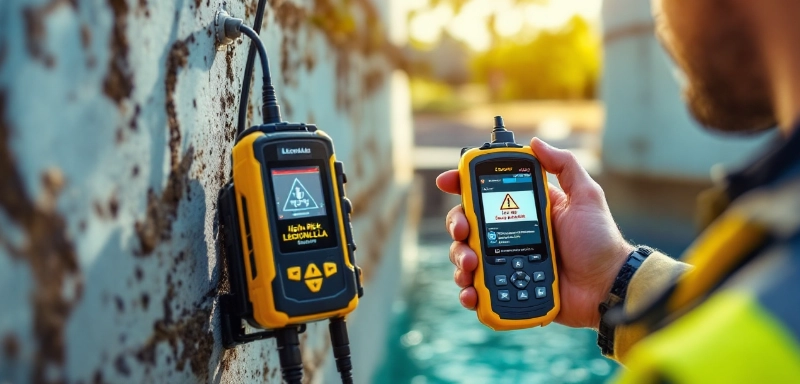
By integrating IoT-enabled
sensors, facility teams can continuously track the key conditions that allow Legionella to thrive; stagnant water, lukewarm temperatures, and imbalanced chemical levels.

When live readings deviate from safe thresholds, alerts can be triggered instantly, enabling maintenance teams to respond before bacteria multiply to dangerous levels.
One Unified View with MobiusFlow
Most water systems use sensors from multiple vendors, each speaking a different “language.” (protocals and data formats)
Put a block around these protocols and data format to help showcase the types of protocols and data formats we integrate with
No Matter the Protocol, We Connect It
1. Communication Protocols
- EnOcean – Energy-harvesting wireless protocol (no batteries), common in building automation.
- LoRa / LoRaWAN – Long-range, low-power wireless network for IoT.
- Zigbee – Low-power mesh network protocol (common in lighting and smart home devices).
- Bluetooth Low Energy (BLE) – Short-range wireless, often used for beacons and proximity sensing.
- Wi-Fi – Standard TCP/IP network connection for higher bandwidth devices.
- NB-IoT / LTE-M – Cellular protocols for IoT sensors in remote or wide-area deployments.
- BACnet – Building automation protocol (common in HVAC, lighting, access control).
- Modbus RTU/TCP – Industrial control protocol for PLCs and meters.
- MQTT – Lightweight messaging protocol widely used in IoT for real-time telemetry.
- OPC-UA – Secure, platform-independent protocol for industrial automation systems.
2. Data Formats (How the data is structured)
Even if two devices use the same transmission method, they may encode their data differently:
- JSON – Human-readable structured data, common in modern APIs and MQTT payloads.
- XML – Older but still common structured format in some industrial systems.
- CSV – Simple tabular format (common in legacy exports).
- Binary / Proprietary Encodings – Compact, manufacturer-specific formats that require decoding.
- EEP Profiles (EnOcean Equipment Profiles) – Standardised definitions for how EnOcean devices describe their data.
3. Vendor-Proprietary “Languages”
Some manufacturers create closed protocols that only work with their own gateways or software unless you reverse-engineer or use an API. This is common in:
- Older BMS/BAS systems
- Specialist industrial equipment
- Some smart building platforms that “lock in” their ecosystem
MobiusFlow acts as the integration layer, aggregating all that disparate data into one compliance-ready dashboard.
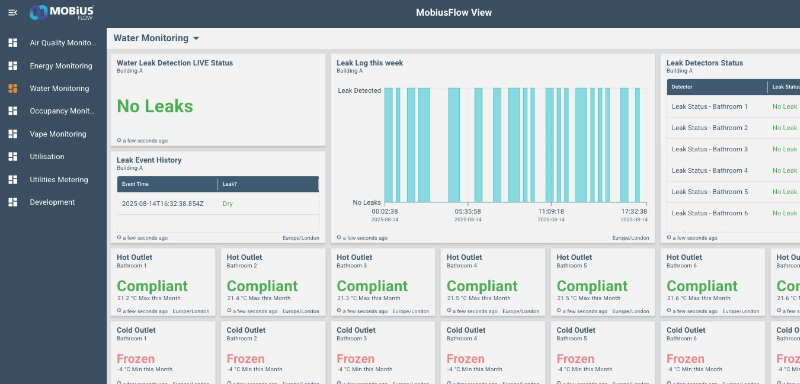
All readings are normalised, logged, and made available in real time for both operational decision-making and compliance audits.
From Detection to Action, Automatically
Real-time monitoring with MobiusFlow doesn’t just flag risks it enables automated responses.
Imagine this:
- A sensor detects water in a cooling tower dropping into the 20–45°C danger zone
- MobiusFlow instantly sends an alert to facilities staff
- A work order is automatically generated to flush the system or adjust treatment
- Compliance logs are updated without any manual input
This proactive loop eliminates dangerous delays and reduces the chance of a Legionella outbreak.
Compliance, ESG, and Peace of Mind
Continuous monitoring also simplifies public health compliance and supports ESG reporting. Instead of manually compiling logs, facilities teams can generate instant reports that prove systems were safe and properly maintained, a major advantage during inspections or audits.
Prevent Outbreaks Before They Start
Legionella prevention isn’t just about reaction it’s about staying ahead of the threat. By uniting multi-vendor sensor data into one intelligent platform, MobiusFlow helps you:
- Reduce outbreak risk
- Streamline compliance
- Optimise maintenance schedules
- Protect public health and your organisation’s reputation
See how MobiusFlow can integrate with your existing water quality sensors to give you continuous Legionella risk monitoring — without costly rip-and-replace projects.
